Key Findings
We performed three contextual inquiries with college students (two from Williams and one from Keynon) who all consider themselves to be art amateurs. One was entirely unfamiliar with WCMA, one had worked there as a guide for two years but had never taken an art or art history class and one was a student who had never been there before and did not identify as a “museum person.” From our inquiries, we learned about how non-art-experts feel in museums, what they like to look for in art, what they naturally notice about art and how long they can feel stimulated in museums. While our participants each gave unique answers to our questions, taken together we were able to find common themes that will certainly help us design an interactive product that will enhance the museum experience of people who are not naturally inspired by the space. We found that each of the participants showed that they enjoyed thinking interpretively about the art and noticing details to try to understand the meaning of the work. We believe we can design a product that will take advantage of this desire for a more active mental state to help build a more joyful and rich museum experience for our users.
Affinity Diagram Theme & Process
Ultimately, we ended the affinity diagram process with ten distinct categories. These are: museum environment reading plaque to understand art understanding the meaning of art thought process when you don’t understand the art being an art amateur impacts my museum experience not enough time for museum what you are “supposed to do” in museums / the “right experience” we start to feel bored in museums concrete observations about art thinking about the art in relation to the artist
To get there, we first laid out all sticky notes on the table and took a few moments to read each other’s data points. We chose to talk and collaborate while building the diagram, rather than doing it silently. The process started slowly, with one of us suggesting a connection and moving it somewhat hesitantly once someone agreed. After the first couple of sticky notes were moved, the process started to pick up speed. We stopped waiting for a full consensus and instead said things like “We can move this later if we want, but maybe it goes here,” while moving a note on our own. To reach the themes we’ve now identified, several of the groupings were broken up, reformed, and grouped differently several times. We grappled with defining groups related to “concrete observations” and “understanding the meaning of art,” as these categories in particular had substantial overlap. We eventually decided to separate them as the thought process of the participant in each situation was distinct. When presented with situations like these, in which the boundaries between the content of groupings were blurry, we tried to get in the heads of our participants. What were they thinking at this moment, and why were they making this choice? We used that perspective to differentiate between groupings by focusing on the intention or feeling of the participant, rather than the actual words on the sticky note.
Affinity Diagram
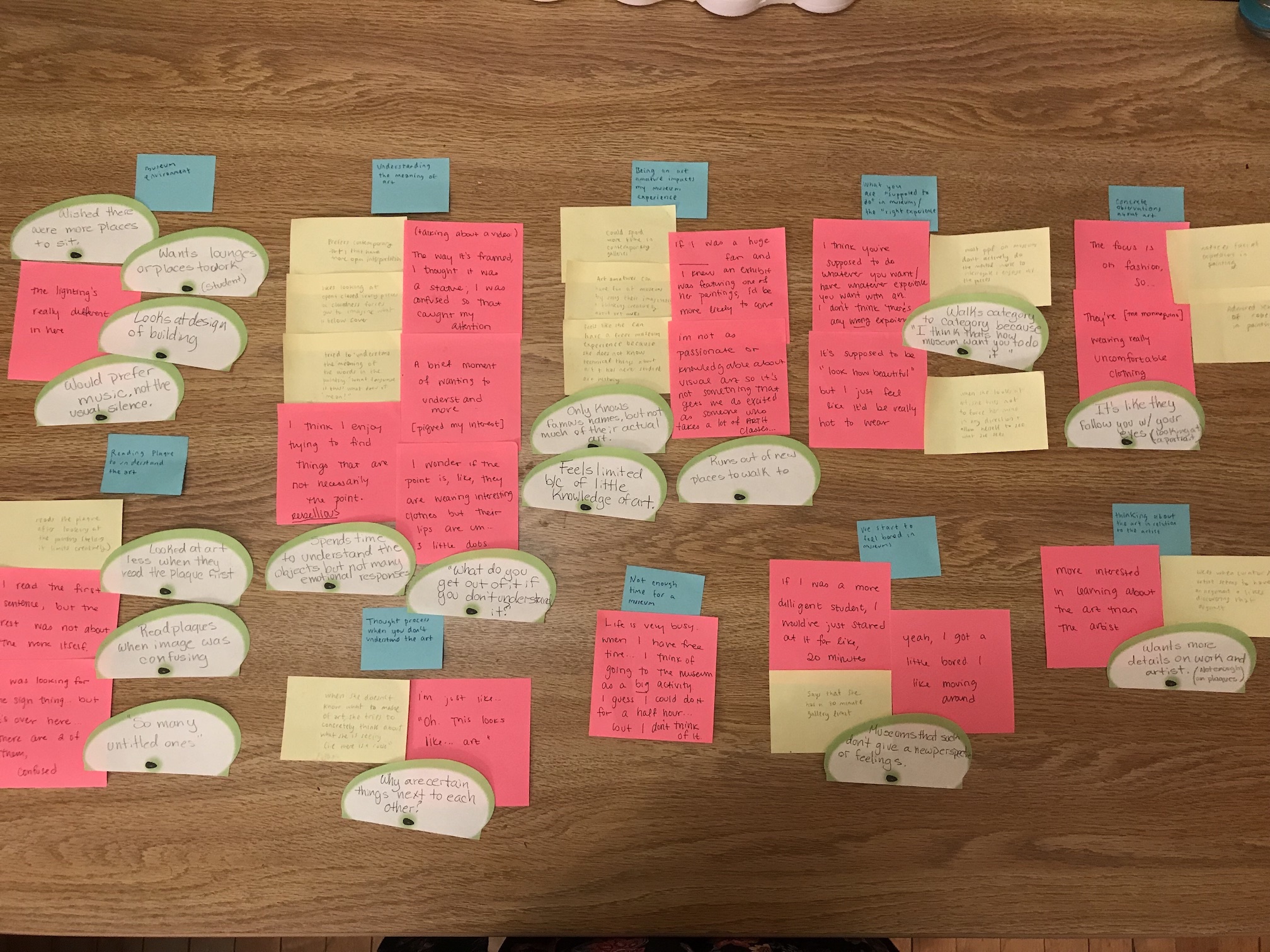
Process
For each of our participants, we often asked them about their body language and movements with questions like, “That piece just caught your eye - how come?” or “I noticed you didn’t spend very much time in this room, is there a particular reason?” Questions like these helped us to collect the data we really need, as we could tell that they sometimes felt awkward continuing with a continuous explanation of this seemingly simple situation. Prompting them seemed to help them feel more comfortable and keep the conversation flowing. Often their responses to questions would prompt more questions. For example, when interviewing E, we asked about his tone of voice and facial expression (“I notice you’re laughing while explaining your decision, why is that?”) This helped us to get more clarity and understand the emotions behind his words.
Contextual Inquiry Results
Our first contextual inquiry participant was S, a Williams College junior. Though S is not an art-history major, (she studies french and psychology) she is intimately familiar with the WCMA collection because she works there twice a week as a gallery guide. In this role, she sits in the exhibits, greets people, answers questions and occasionally gives museum tours. She was inspired to apply for this position after she spent the summer before freshman year of college visiting museums with her friend who had intensively studied art history where she realized that her lack of knowledge about art allowed for her to have a freer museum experience in which she could use her imagination without getting bogged down in history or artistic technique. She hopes in her job to help visitors who feel intimidated by the art use their imagination freely to enjoy the works. Though she loves museums, she admitted that after thirty minutes in WCMA she reaches her “museum limit.” When asked what would increase her museum tolerance, she said that more interactive galleries would probably lengthen her visits.
Our second contextual inquiry participant, E, is a sophomore at Williams. He has not yet declared a major, and does not consider himself a “museum person.” His visit to WCMA for the contextual inquiry was his very first time entering the building. The inquiry took place on a Thursday morning while several students (possibly a class) and community members were milling about the museum. There was a fair amount of ambient noise in the form of chatting between students, and there appeared to be another contextual inquiry taking place in the same exhibit! I explained the nature of a contextual inquiry and the almost master-apprentice dynamic to E, and told him that I’d like him to move through the museum however felt natural to him while I followed and asked questions about his choices. I could tell by E’s body language that he had a lot of energy - he was fidgety and didn’t stay at any one piece for long. He explained that he likes to move around and was getting bored. He thought “a more diligent student would stare at it for 20 minutes”, whereas he preferred to read the first sentence of a plaque to get an idea, and then move on. He made several jokes about the art, saying multiple times that his comments probably “not the point,” and that he thought he was supposed to be thinking “how beautiful,” when actually he’s thinking about how uncomfortable the clothes look (in the Jacob’s Pillow exhibit).
Our third contextual inquiry participant, U, is a junior at Kenyon College in Ohio. She is a psychology major that showed interest and support for the design process we are learning in HCI. She does not consider herself an expert in art and has not taken any art history or studio art classes. The contextual inquiry was her first visit to WCMA, so she had a fresh perspective on the museum and its art. I told her to think of me as her shadow who knew nothing about museums and may ask alot of questions. I gave her no special instructions; I just told her to visit the museum as if she had come on her own. I soon realized that she cared about the space just as much as the actual art. She commented on the architecture and ambience as much as the art pieces. What I found most unique and interesting about this participant was her focus on the ambience of the museum. She wanted to listen to music as she viewed the music, and said it would make her more comfortable then the usual silence of the museum. She wanted to find places to sit and enjoy the art. Perhaps she would have enjoyed videos or presentations that allow her to sit and experience the art. Unfortunately, participant U would easily become distracted, check her phone, or veer off the focus of the inquiry. It seemed like nothing truly engaged her. She described her museum experience as boring. Her suggestion was to create a multimedia experience for the museum’s pieces that allowed for a more “hands-on” experience.
Results
None of the three people we interviewed cited themselves as art experts and all three admitted that they can become bored in museums. One explained that she regrettably had a 30 minute gallery limit while another felt like if he was a more “diligent student” he could have spent more time looking at the art. Therefore, they seemed to feel that their limited museum tolerance made them seem regrettably less intellectual. They also all referenced the idea that there exists a “correct” way to visit a museum. One participant felt she was supposed to visit the galleries in a certain order because “that’s how the museum wants her to do it.” Another felt that most viewers don’t do the active mental work of fully engaging with the artworks and were missing out on the museum experience. The third, contradicted the others’ claims saying that he personally does not believe that there is any “wrong” museum experience. His tone suggested that he was refuting a commonly held belief that museums should be experienced in a certain way. All three also discussed how being an “art amateur” impacted their museum experience. One interviewee said that her limited knowledge of art history and artistic techniques allowed her to view the art more imaginatively and creatively while another felt that his lack of knowledge made him less excited to visit museums.
Many of our most salient results related to how our interviewees view art. When asked about what they were thinking about when they initially looked at art, many cited concrete observations about the work. For example, one participant noticed the facial expressions in a painting and admired the texture of the clothing in the work. They then often moved to trying to understand the meaning of the work of art. One interviewer said that her favorite pieces of art were often contemporary without a clear meaning. For her, the act of trying to understand and interpret the possible meaning of the piece made looking at art more fun and mentally engaging. Another interview subject said that he enjoyed looking for “rebellious” interpretations of the art meaning that he liked looking for possible meanings that might be less obvious and more controversial. A third participant said that she spends time trying to understand art but does not feel like she has an “emotional response” to the works. In other words, it seemed that understanding the meaning did not make give her a more impassioned viewing experience.
In analyzing what our participants said about looking at the plaques that often accompany works of art, it seemed that they did not feel like contextual knowledge greatly enhanced their museum experience. One said that she “looked at the art less” when she read the plaque first. This was echoed by another participant who said that she only reads the plaque after looking at the art for a while because she feels like it limits her ability to think creatively about the work. Our third participant said that he often stops reading the plaque because he is not that interested in learning about the artist and just wants to think about the work of art.
Task Analysis Questions
1. Who is going to use the design?
Our project is intended for use by people who become bored in traditional museums. More specifically, we want young adults or students to use our product.
2. What tasks do they now perform?
They currently walk through the museum without any guidance and stare at art without engaging with it. They spend about one or two minutes looking over the pieces that come across their path. No person seems to look for a specific artpiece.
3. What tasks are desired?
Participants all desired for more entertainment within the museum or guidance while they walk. They want some sort of engagement, or anything more stimulating than the traditional museum experience. Based on the emphasis in our data points on understanding or lack there-of, this engagement should be focused on potential meanings of and observations about the art.
4. How are the tasks learned?
Based on the participants responses it seems like there is no easy way to know how to experience a museum. Most data points indicate that the participants view higher education as the only way to know how to engage with the pieces in a museum.
5. Where are the tasks performed?
Participants would walk across the large gallery floors and walk alongside the walls of the space.
6. What is the relationship between the person and data?
Two of our participants (U and E) had never visited WCMA before their contextual inquiries, while the third (S) is an active member of the museum community. For S, these data points may be ideas that she’s thought of many times while interacting with the museum in her daily life. U and E, on the other hand, had probably never before considered their thoughts on the questions we asked them and their relationship to the museum. Both of these perspectives are important because while many of S’s data points have been considered and thought through, U and E offer a fresh and more spontaneous perspective on the museum.
7. What other tools does the person have?
The person has their phone to search for more data on certain pieces or artists. They tend to use the plaques on the art pieces to guide them through their internet searches, though one of our participants admitted that he didn’t want to read the full plaque because it seemed boring.
8. How do people communicate with each other?
Within the museum space, users communicate with each other in low voices because of the quit atmosphere. Participant U tended to worry about making too much noise through conversation.
9. How often are the tasks performed?
The act of walking to a piece and observing it happened about every 3 minutes for participant U. There were brief pauses where she checked her phone or sat down and blankly stared at a larger piece for a prolonged period of time. Participant E walked through the exhibit in a more continuous fashion. He seemed to be taking in the exhibit as a whole, and only paused when something in particular caught his eye.
10. What are the time constraints on the tasks?
The time constraints depends on the participants daily schedule. Some had large expanses of time to wander through the museum without any sort of rush. Others made it clear that they did not have time to visit museums.
11. What happens when things go wrong?
When things go wrong the user becomes bored of the pieces within the museum. They eventually do not know what to do and consider leaving the museum.
Design Plan
Based on our contextual inquiries, we will brainstorm a product design that users can use when they are in a museum. As they seemed to enjoy talking about their thoughts about art, our design will allow them to communicate their ideas to other users in some form. In addition, because our users suggested that they enjoy engaging with art more actively, our product will help jolt their brains, asking them to interpret the meaning of a work of art or pushing them to appreciate details about the work. We plan to think about games and rewards to motivate our users and make our product fun.