Research Review: InterprArt
Team
- Abby Miller, Designated Delegator
- Grace Murray, Logic Liason
- Maria Mejia, Creative Consult
Problem and Solution
“I’m not really a museum person” is a commonly uttered summary of many individuals’ relationships with museums. When pressed, the speaker often explains that they don’t actively dislike the act of looking at art. Rather, they find themselves bored at museums, intimidated by the knowledgeable people surrounding them who can spend seemingly-unlimited amounts of time gazing at a single work. The validity of this statement seems questionable when examining the evolving, innovative museums of this era. In recent years, many museums, including the Williams College Museum of Art, have broadened the scope of museum exhibits. For example, the current display in (tiny) WCMA features exhibits that incorporate dance, biology, technology, history and classic art. This interdisciplinary, multi-media, approach to designing exhibitions is becoming more popular and making museum visits more enjoyable and accessible. So why do so many people still believe that museums have nothing to offer them? What tools can we create to help people discover that looking at art is an activity anyone can enjoy? We at InterprArt believe that the reluctant museum viewer needs an activity for their visit that occupies their brain so they do not feel bored, and empowers them with confidence in their ability to critically view art. Specifically, we believe that visitors need a push to interpret and critically engage with art and that we can build up confidence by pointing to the strengths in their interpretations. Our smartwatch application will ask visitors about the meaning of a work of art and allow the user to respond conversationally, giving them a mental jolt (a reminder to engage with the art) without detracting and distracting from the experience of viewing the art itself. By allowing visitors to listen to the interpretations of other museum guests and by offering rewards for interpretations, we will bolster users’ confidence in their ability to view art critically and make the act of interpretation collaborative and joyful. (Full Project proposal can be found here.)
Design Research Goals, Stakeholders and Participants
For our research, we conducted three contextual inquiries. Through these contextual inquiries, we wanted to understand how people who are not naturally confident in museums interact with the space. Specifically, we wanted to know how they moved through galleries and what they thought about when they viewed art. We also hoped to discover what they liked and disliked about museums. With this in mind, we performed three contextual inquiries with college students (two from Williams and one from Keynon) who all consider themselves to be art amateurs. Our first contextual inquiry participant, a Williams College junior, was the most familiar with the Williams College Museum of Art. Though S is not an art-history major, (she studies french and psychology) she is familiar with the WCMA collection because she works there twice a week as a gallery guide. In this role, she sits in the exhibits, greets people, answers questions and occasionally gives museum tours. Our second contextual inquiry participant, E, is a sophomore at Williams. He has not yet declared a major, and does not consider himself a “museum person.” His visit to WCMA for the contextual inquiry was his very first time entering the building. Our third contextual inquiry participant, U, is a junior at Kenyon College in Ohio. She is a psychology major that showed interest and support for the design process we are learning in HCI. She does not consider herself an expert in art and has not taken any art history or studio art classes. The contextual inquiry was her first visit to WCMA, so she had a fresh perspective on the museum and its art.We began each of our inquiries with a preliminary interview to assess the participants background. We then took the participant to the WCMA gallery and asked them to walk around and watched which art-works they gravitated towards and how long they stood at an individual work of art. After a brief period of observation, we began to interact with our participants as they looked at the art, asking them about their thought process and making interpretations. We sometimes asked them explicitly about what they thought a work of art “meant” and sometimes asked them more general questions about what they observed. We ended the inquiry by leaving the gallery and asking them to reflect on what they enjoyed thinking about as they viewed art. Through this procedure, we hoped to gain insight on how people felt in the gallery and whether they enjoyed critically engaging with art.
Design Research Results
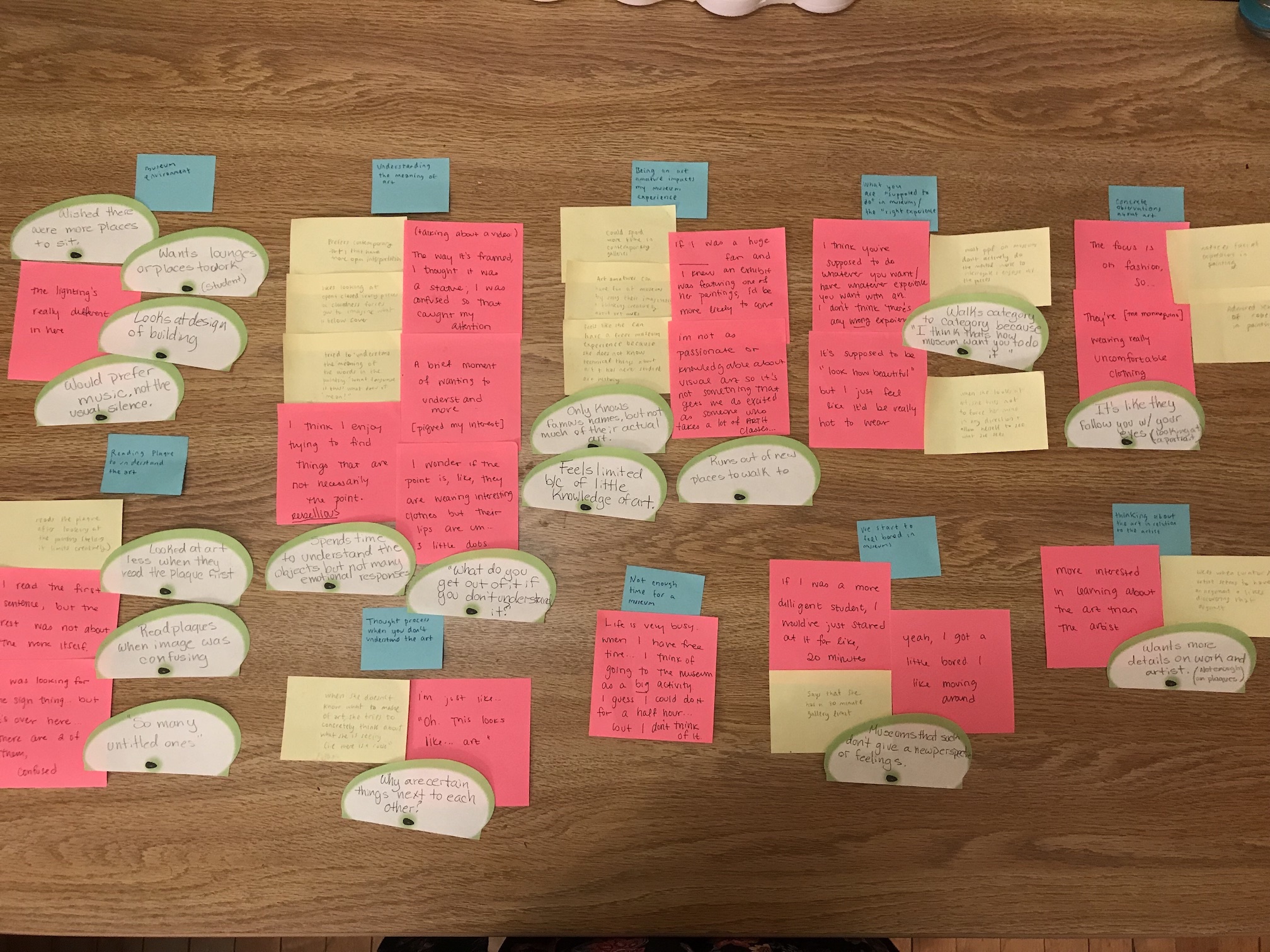
During our design research, we found that all our contextual inquiry participants considered themselves to be art amateurs at least at some point in their life despite their varied backgrounds in art and art history. Because of their limited knowledge on art, two participants felt that their experiences at a museum and interpretations of art pieces were not sophisticated enough to be confidently shared. This thought process was most likely a result of their described notion of a correct museum visit where experts methodically walk through a museum and use given information to decipher an artist’s original intentions. Our design idea of user validation stemmed from this mentality. However, the other participant believed that there is no such thing as an invalid interpretation or museum tour. An artist’s original message is not necessarily the interpretive ideal, especially when user interpretations are made for entertainment instead of educational purposes, which is an important distinction we discovered in our research. While an art piece’s common symbols may be noticed by most museum visitors, their analysis can vary based on whether they emphasize recreation or education during their museum visit. More specifically, some users like to provide “rebellious” or unique interpretations while others prefer to simply match an expert’s point of view. But, it is important to note that neither attitude considered the actual act of interpretation as a chore. Therefore, we decided to focus on designs that provide a means for users to feel heard when they are confident in their interpretations and validated otherwise. (Full contextual inquiry review can be found here.)
Task Analysis
Our design is intended for use by people who become bored in traditional museums. More specifically, we want young adults or students to use our product in order to avoid their previous tasks of wandering through museums and barely engaging with the art. They want more entertainment and comprehension of art within the museum through an engaging process. Users would learn that their museum experience is as unique as they are by using our design that places an emphasis on open-ended, interpretive categories. They would engage with the art and our design as they walked along museum galleries. Our users both engage with and provide the data for our design. However, it is important to note that a user’s relationship with our data can be one of complete skepticism or one that treats our data as a guiding principle for interpreting art. Users could also use both the plaques provided by the museum and their smartphones as secondary tools to search for further information on an art piece. Since museums tends to be quiet spaces, users that visit together would simply communicate their thoughts or discoveries through whispered conversation or digital messaging. In the interpretive context, this would happen after brief pauses between every art piece that the user(s) would walk to or about every three minutes. The time spent on each task, however, varies greatly on a user’s schedule; some barely have time to visit a museum in the first place. So if there is not enough time, patience, or confidence, users eventually become bored and prematurely leave a museum.
(Full task review can be found here.)
Themes and Proposed Design Sketches
Original design sketches can be seen here.
Smartwatch app: auditory discussion board
The watch implementation would enable the visitor to interact with the art using InterprArt unobtrusively, without the distraction of constantly having their phone out or needing to go to a separate location to submit their interpretations. It would involve using audio transcription to submit interpretations because the small screen is not conducive to typing. The screen would then include a menu where other audio transcriptions could be browsed for collaborative purposes. This implementation would also use vibrations and on-screen celebration graphics to signal achievements or rewards, which could then be used for any game functionalities.
In-gallery Desktop: email-based interpretation correspondence
Users will be given a pamphlet upon entering the museum alerting them that if they wish, they can think about what the art means and enter their interpretations on the in-gallery computers to see other interpretations. This will help give their museum visit some purpose and give their brains an active question to think about. The user will enter their email address and the date for each interpretation they provide and if they do a certain number of interpretations then they will qualify for rewards. If they wish, the user can have their interpretation emailed to them so that they can keep a record of their feelings about the art they interacted with. This will help them to clearly remember their visit to the museum and can even allow them to track how their feelings about a specific work of art change over time should they choose to look back.
Smartphone app: a visual discussion board incorporating text and images
Users can choose to visit a museum mobile site where they can share their interpretations with other visitors in an online forum. A user would approach a painting, then open the mobile site to post an interpretation, read other interpretations, find an art challenge, or look back to their museum visit. Users could use the camera functionality on their phone to take photos of images that match certain prompts given by the mobile site. The forums would facilitate collaboration between users. By using a smartphone’s location features, the site could keep a record of a user’s steps throughout the museum to assist the task of recording a museum visit. Finally, by attempting to match a user’s interpretation to verified expert interpretations, the mobile site provides a means for rewarding users.
Design Chosen
We decided to develop a smartwatch design for our proposed tasks of collaboration, validation, memory-recording, and interactive engagement. The smartphone design is too ambiguous, and the desktop computer could cause users to spend too much time walking back and forth between viewing the art and commenting about it. The smartwatch provides the most subtle or unobtrusive means of guiding a user throughout the museum visit, which is important for each user to still have a unique museum experience. We do not want to hinder a user’s freedom to walk their own path within the museum and to view only the art pieces that interests them. It allows our design to feel like optional entertainment that is less rigid than a predetermined museum tour. The small screen ensures that a user’s focus is still on the museum’s art pieces instead of a larger screen that may be more entertaining for younger users. Furthermore, a smartwatch is constantly in contact with the user, which means our design can notify visitors through physical touch as opposed to alarms or pings that can interrupt the quiet atmosphere of most museums.
Written Scenarios
Scenario 1: Facilitate conversation and collaboration about art:
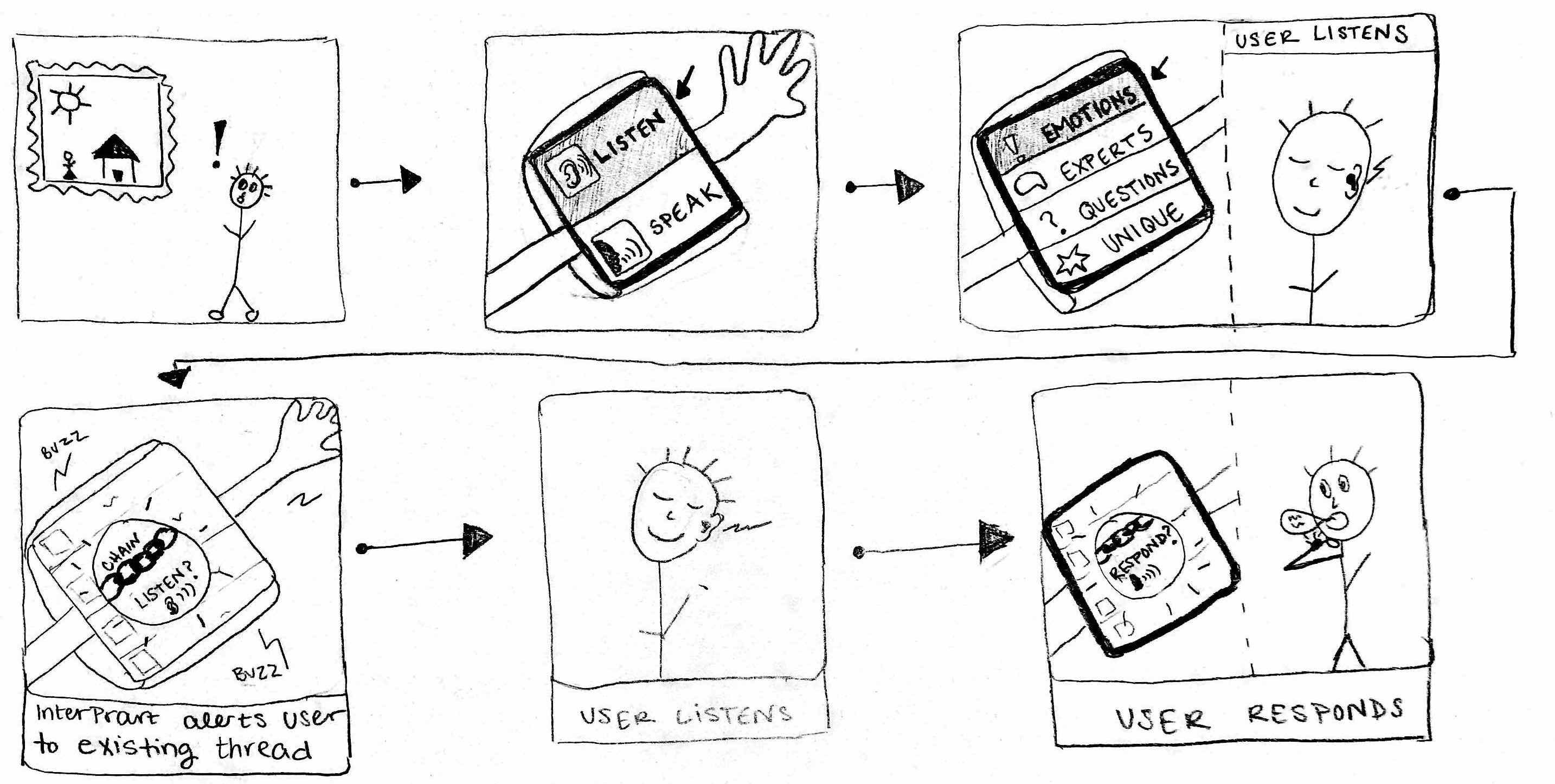
Sam is a student at Williams who enjoys art, but doesn’t have many friends who share this interest and would want to engage in discussions on the subject. One day, while visiting the art museum solo, Sam, is particularly intrigued by a painting in a new exhibit. It reminds him of his childhood, and he feels extremely nostalgic. Wondering if other museum visitors shared this experience, Sam puts in his wireless earbuds and opens up the InterprArt app on his smartwatch. He selects the listen icon, and is taken to a screen of categories, where he selects emotions. Sam listens as the app narrates the 5 most recent interpretations. At the third interpretation, his watch buzzes briefly and a chain icon pops up to indicate that this interpretation has started a thread of responses. He taps the icon to listen to the thread. When it’s finished, he taps the speak icon. When the screen indicates that the app is “listening” with a blinking red recording light, he explains his own experience of nostalgia in response. Sam feels happy that even while visiting the museum alone, he was able to engage in discussion about his new favorite piece of art.
Scenario 2: Receive rewards and validation for interpretations:
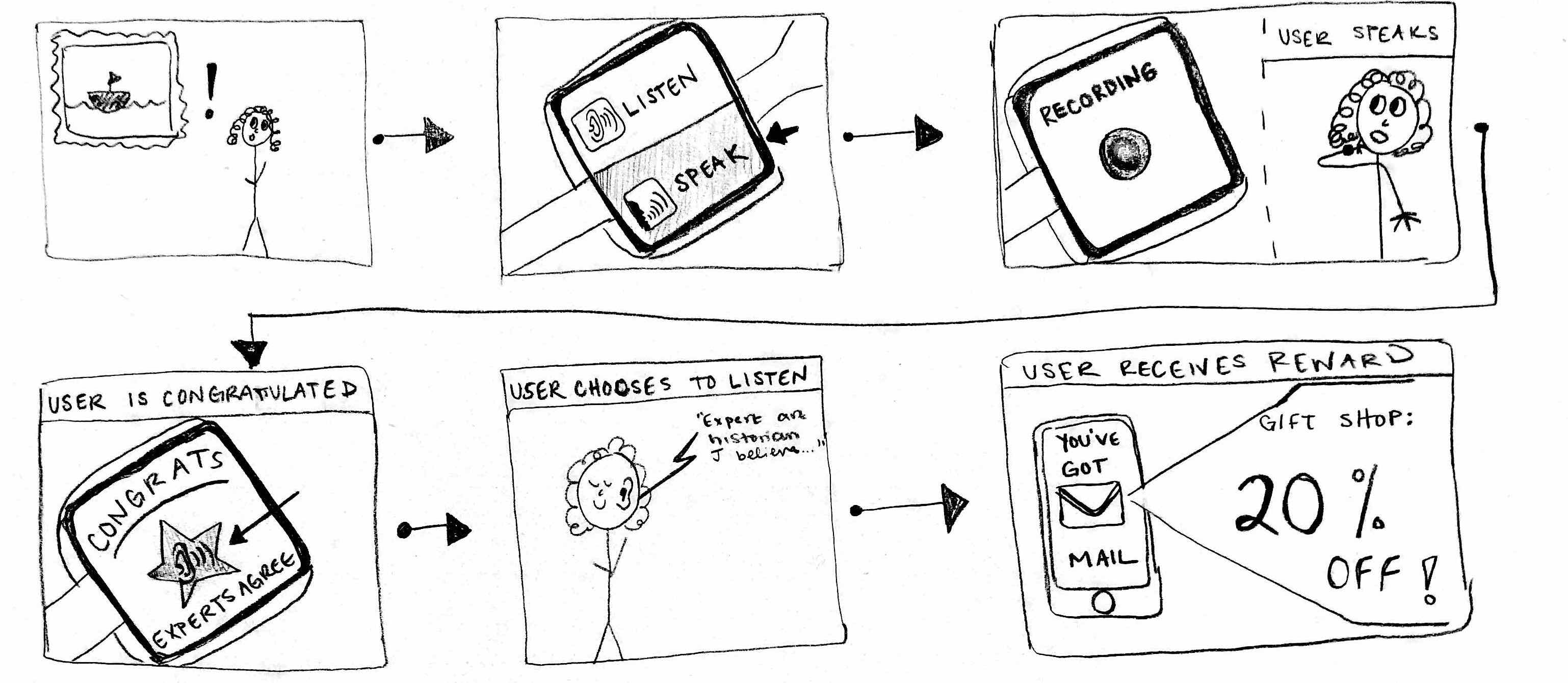
Betty is a student who has never taken a class in the art or art history department, and doesn’t feel very confident in her art-related thinking. She does, however, enjoy looking at art and visiting the art museum! One day, while browsing an exhibit, she is struck by an interesting thought while examining a sculpture and wishes she had someone to tell! She opens up the InterprArt app on her smartwatch and taps the speak icon. When the blinking red recording symbol indicates that the app is “listening,” she quietly dictates her interpretation. Normally, Betty is nervous to share her thoughts on art, for fear of others’ judgement, but she feels comfortable whispering it into her watch. When she taps on the screen to indicate that she is finished speaking, her watch suddenly vibrates excitedly. Colorful stars pop up, and balloons drift across the screen, along with the words, “Congratulations! Experts agree!” Intrigued, she taps on the highlighted listen icon, and listens in in her wireless earbuds to a similar interpretation that has been put forth by an expert art historian. Betty feels encouraged and validated. Her watch buzzes on her wrist and she sees she has received a star! When she collects 5, she will level up!
Presentation
To see presentation click here.