Design Check-In
Tasks To Support:
Facilitate Collaboration and Conversation About Art
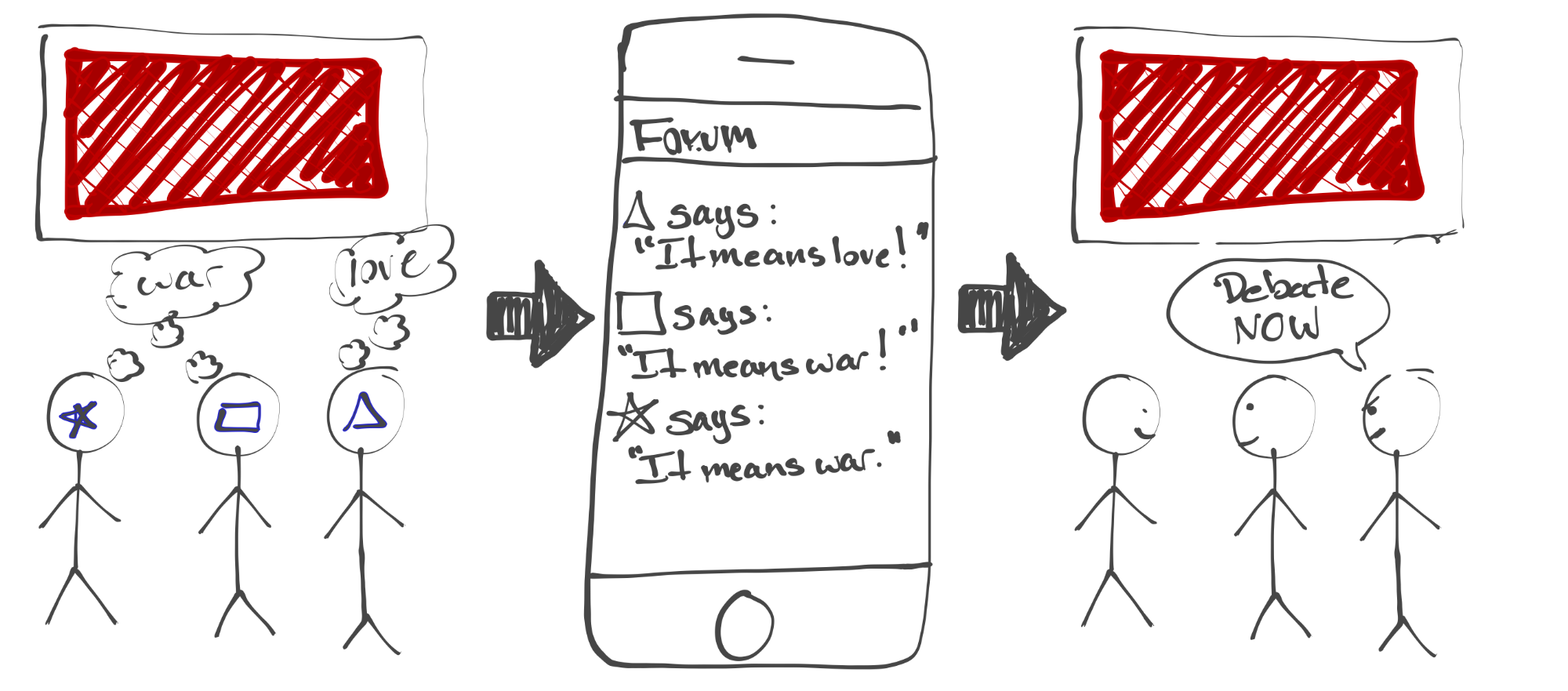
Amelia likes to spark conversation by sharing controversial opinions. She feels like she learns through formulating arguments and loves to have spirited debates with friends. When she visits museums, she often feels that they are eerily quiet. She gets restless and becomes eager to leave. She wishes that she could share her thoughts about the art she sees with others–having discussions about the pieces would help her feel more stimulated and interested in the artwork.
Create a More Mentally Active Museum Visit
Dennis does not know what to think about when he looks at a piece of art. When he goes to a museum, he feels like everyone around him can stare at pieces for endless periods of time and he wishes he knew what they were thinking about. He feels self-conscious when he walks around the gallery too quickly and tries to stand in front of each work for an “acceptable” period of time. This anxiety makes his museum trips feel prolonged and unstimulating. He wishes that he had a task or question he was trying to answer when he studied the art work. If he had something concrete to think about with each work of art, he thinks he would feel less stressed out and bored in museums.
Walk Through the Museum Without Guidance
Henry hasn’t spent much time in museums, but bored on a rainy Sunday afternoon, he wanders over to WCMA to explore. When he enters, he is presented with multiple possible directions to wander, and he pauses for a moment. The greeter behind the desk seems like she’s about to ask him a question, but wanting to avoid a possible guided tour or manufactured museum experience, Henry quickly chooses to go upstairs, avoiding the help of the greeter. Once upstairs, Henry is drawn into an exhibit because the music playing inside sets it apart from the other rooms. He lets himself wander aimlessly, not forcing himself to look at every piece, and only inspecting the ones that naturally catch his eye. He notices other visitors reading plaques, but isn’t interested in absorbing this information. Henry wants to think his own thoughts and experience the art independently of a predetermined perspective.
Use an Interactive and Educational Game to Teach/Learn
Maggie is a high school teacher and she wants to try out a unit with her students about art history. She brings them to the art museum, and the group goes on a guided tour. Many of the students don’t seem to be listening to the tour guide, and nobody takes notes. Maggie worries that her students aren’t engaging with the art, and wishes there was a way they could bring their own thoughts to the table while also learning historical content. Coming to the museum seemed better than a powerpoint presentation, but now Maggie thinks she needs to make this field trip even more interactive.
Earn Rewards and Receive Validation for Interpretations
Rebecca is a college student that has some background knowledge in art history. When she visits an art museum, she likes to create her own interpretations of the art pieces. However, she never knows if her interpretations are correct or close to the artist’s original message. She consults the plaque next to the art but only finds general information such as its medium, artist and title. Rebecca attempts to search online for an official interpretation, but the search results give a variety of interpretations without any measure for validity or expertise from the users that posted them. Rebecca’s inability to validate her interpretations discourages her from trying more; she has no way of measuring her improvements and no incentive to continue.
Stare at Art without Engagement
Sterling’s friends convince him to visit an art museum with them even though he has no background in art. He quickly notices that they stare at the art pieces for a few moments before commenting on the significance of the piece or their emotions towards it. However, when Sterling attempts to do the same he sees and feels nothing. Sterling does not recognize any key features or themes within the painting and cannot empathize with the original artist. As a result, Sterling simply follows his friends around the museum and mimics their stares at the art without thinking anything. He soon becomes bored and decides to not accompany his friends the next time they visit an art museum.
Create a Record of a Visit to the Museum
Dana spent the morning at the museum and then met a friend after for lunch. The friend asks her about her experience at the museum and Dana says that she liked it okay. The friend presses further and asks what art she saw and liked. Dana thinks back and has a hazy memory of what sorts of things she liked: a painting with leaves, a metal sculpture and a watercolor but she cannot remember what they are called, who painted them or what exhibit they were a part of. She wishes that she had a concrete record of the art she interacted with so she could describe it to her friend. In addition, she feels like her visit would have felt more personally meaningful if she could remember what art she liked–then she could learn more about the artists and try to see other exhibits of their work.
In-Gallery Desktop Computer
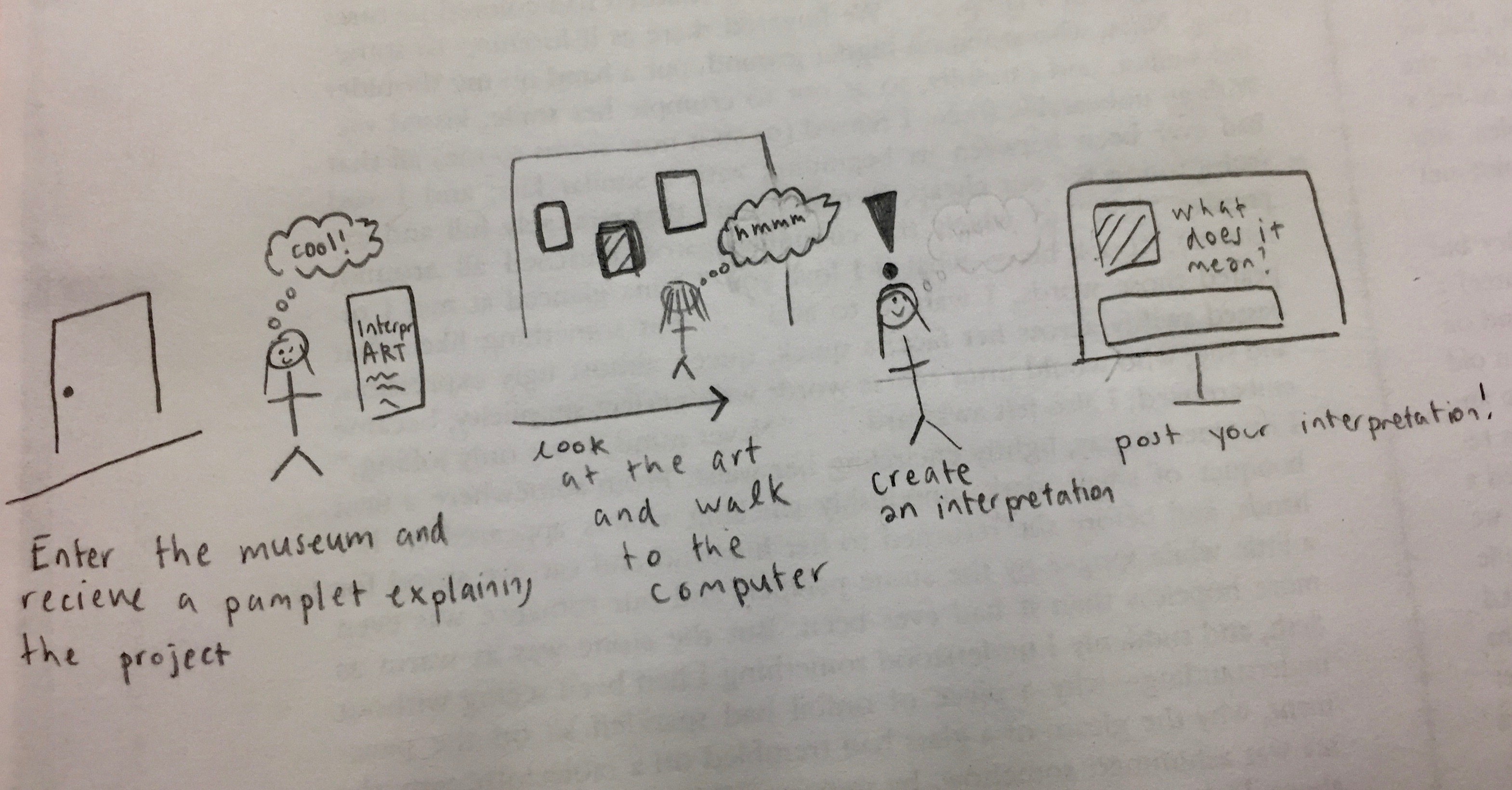
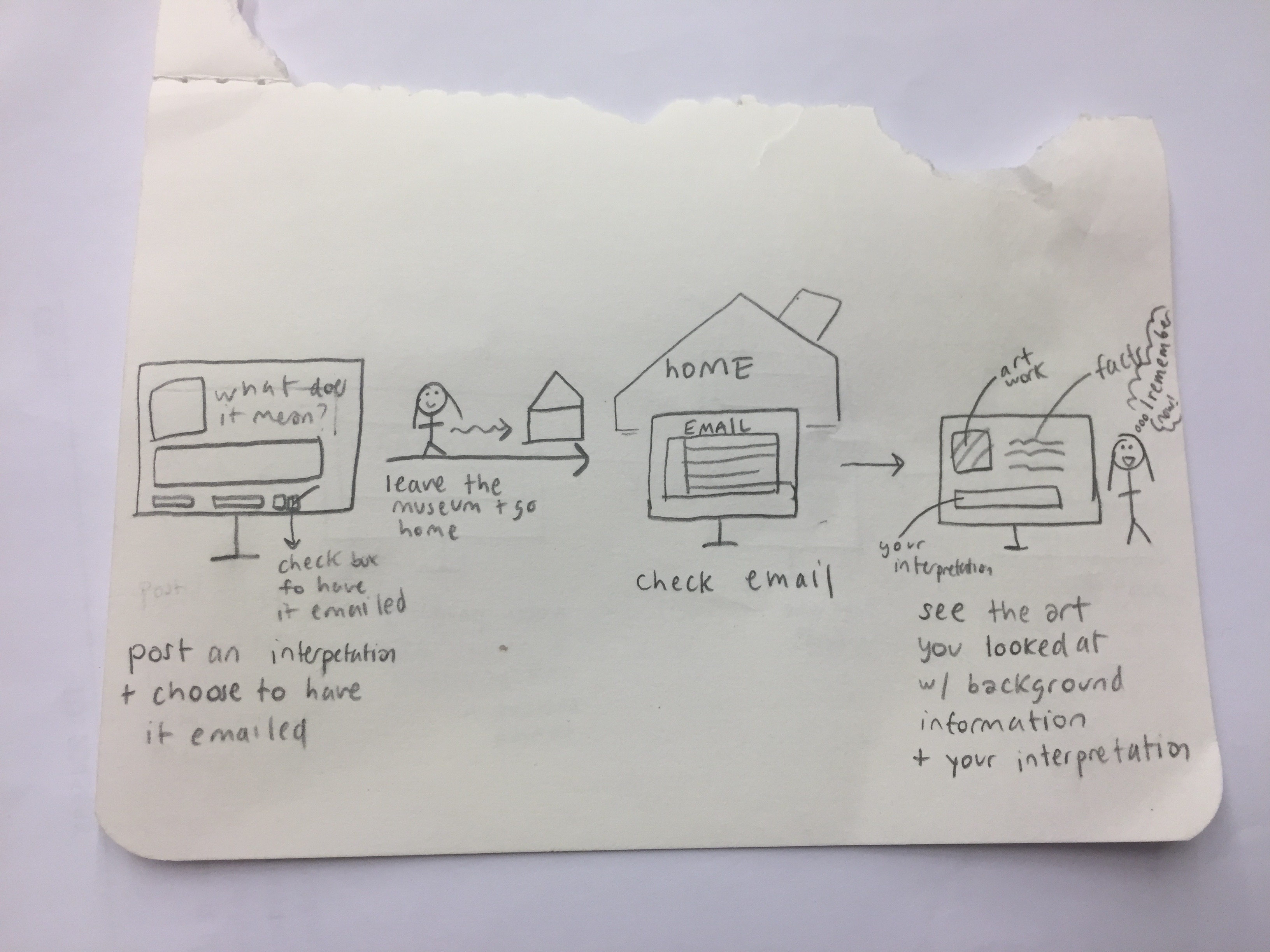
This design is a desktop computer that will sit in an unobtrusive location in the gallery. The user will be given a pamphlet upon entering the museum alerting them that if they wish, they can think about what the art means and enter their interpretations on the in-gallery computers to see other interpretations. This will help give their museum visit some purpose and give their brains an active question to think about. The user will enter their email address and the date for each interpretation they provide and if they do a certain number of interpretations then they will qualify for rewards. If they wish, the user can have their interpretation emailed to them so that they can keep a record of their feelings about the art they interacted with. This will help them to clearly remember their visit to the museum and can even allow them to track how their feelings about a specific work of art change over time (should they choose to look back).
Task 1: Facilitate Collaboration and Conversation About Art
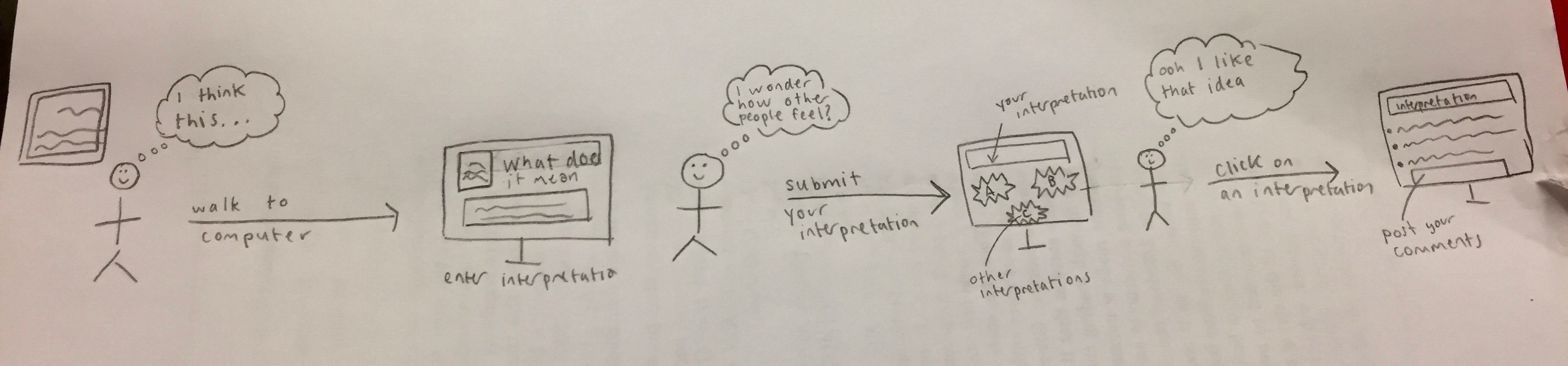
When a user enters their interpretation of an artwork’s meaning, they will be presented with other visitor’s interpretations. If they click on a specific interpretation, they can add a comment agreeing or disagreeing with that user and read a record of previous comments. They can also sign up to receive an email notification when someone comments on their interpretation meaning they can get feedback about their ideas. A moderator will regularly check these forums and delete spam and inappropriate comments.
Task 2: Create a More Mentally Active Museum Visit
When a user enters the museum they will be handed a pamphlet asking them to consider engaging in the project of interpreting the art and creating a collective database of visitor interpretations. This will give them a question to keep in mind as they walk through the gallery and look at the art. In addition, if they are feeling under-stimulated as they passively look at art, they can move to the in-gallery computer where it will prompt them to look at certain artworks and enter an interpretation. Thus, they will have a mission and an activity as part of their museum visit.
Task 3: Earn Rewards and Receive Validation for Art Interpretation
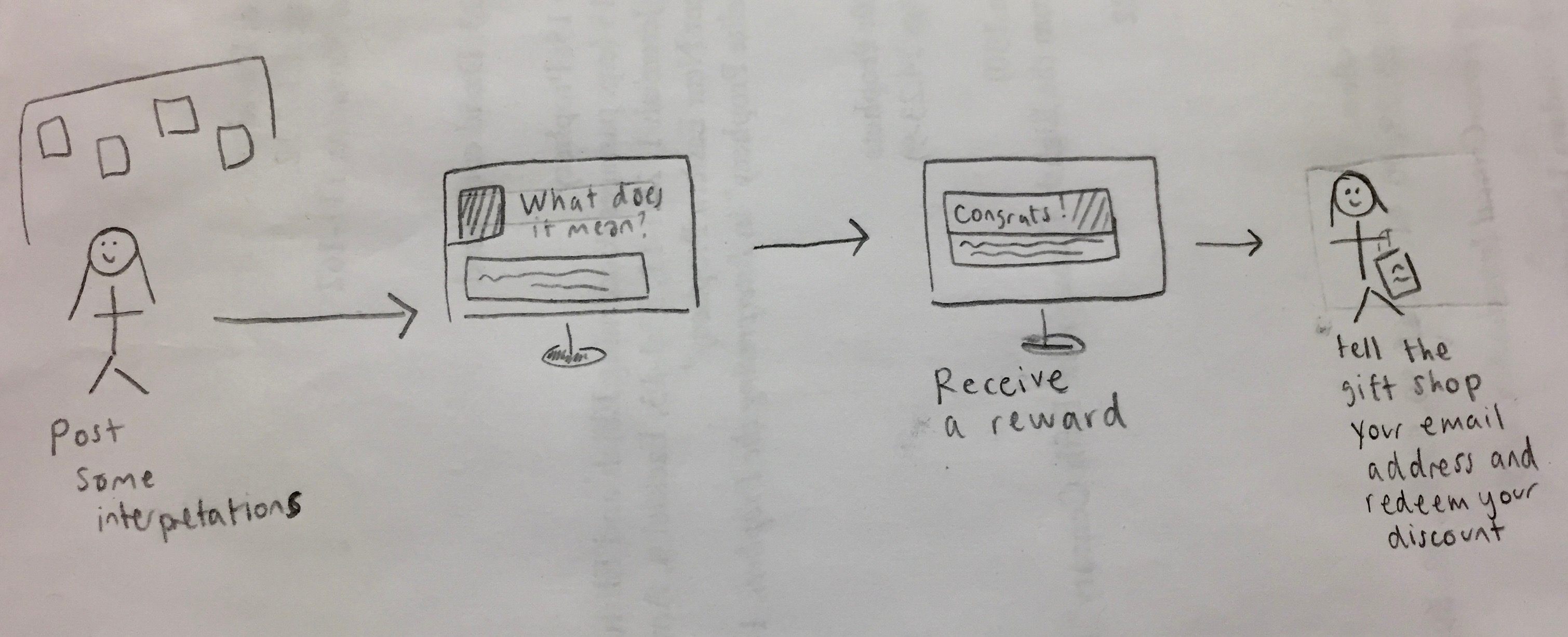
When a user enters an interpretation, the computer will use an AI algorithm to analyze it and quickly return some validating metrics. For example, the app will show you other visitors who had similar responses to the artworks if they exist. If none exist, then they will compliment you for your unique interpretation. In addition, there will be rewards given out for the number of interpretations you produce. You will enter the date and your email address for each interpretation and if you do 10 on a given day then you will get a small discount in the giftshop, if you do 20 then you will get a slightly larger discount, and if you do 50 you will get a small free gift (numbers subject to change!).
Task 4: Create A Record of a Visit to the Museum
When you submit an interpretation of an artwork, you can click a box to ask that your interpretation be emailed to you. Alongside your interpretation, the email will include a picture of the artwork, the name of the artist, the date of the artist and one or two fun facts related to the work. This will allow you to check your email later and remember the art you connected with and do more research should you choose. In addition, you can look back years later and see if your interpretation of a piece of artwork has changed over time.
Smartwatch
This design is a smartwatch app that can be downloaded and used on a museum visitor’s personal smartwatch, and the museum could also implement a smartwatch borrowing system, so visitors could check out a watch for use during their visit (although with this feature, some sort of account would be necessary to distinguish between users). The watch implementation would enable the visitor to interact with the art using InterprArt unobtrusively, without the distraction of constantly having their phone out or needing to go to a separate location to submit their interpretations. This implementation would involve using audio transcription to submit interpretations because the small screen is not conducive to typing. This implementation is accessible to museum visitors of a wider range of age and ability because it involves speaking rather than typing. The watch would also use small vibrations to alert the user to a message on the watch face (more detail on this in task descriptions).
Task 1: Earn Rewards and Receive Validation for Art Interpretation
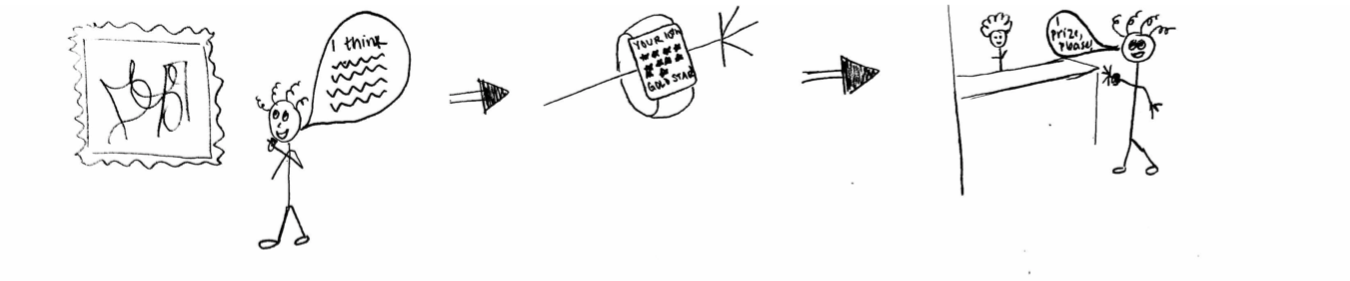
The smartwatch would achieve this task in a manner similar to a FitBit or other wearable fitness tool, and use vibrations and on-screen celebration graphics to signal achievements. The watch would keep track of the number of interpretations you’ve submitted, and when you reach a certain number (e.g. 10), it would vibrate to alert the user and inform them of a small award : “You’ve earned a gold star! Redeem 20 gold stars at the gift shop for a prize!”. This system can be implemented for numerous categories of validation, not only number of interpretations submitted. For example, if more than x people share a similar interpretation, they could each receive a “Great Minds Think Alike” badge, and be alerted on their watch.
Task 2: Facilitate Collaboration and Conversation About Art
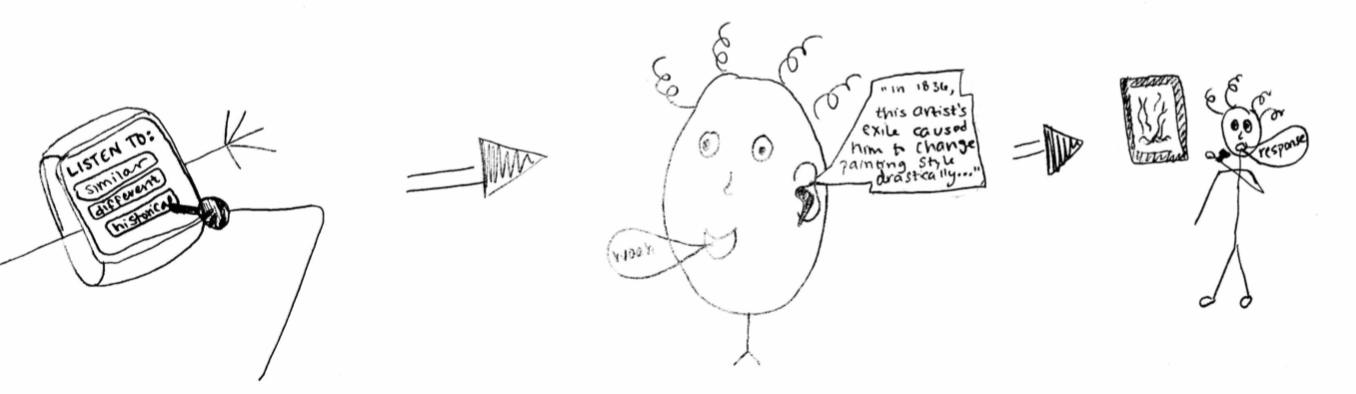
For this task, using earbuds paired with the smartwatch would be useful (and possibly necessary). At each piece of art, users would have the option of listening to others’ interpretations of the same piece of art. They could filter these to find similar, different, unusual, or historically/factually based interpretations. The user could then choose to respond to a particular interpretation with their own ideas. This implementation idea is inspired by PIN ( Karl Bocker, Lester Lee, Alyssa Wang) : http://www.lester-lee.com/curious-places//2018/03/08/design_checkin/.
Task 3: Create a More Mentally Active Museum Visit
The smartwatch would prompt mental engagement with the art by encouraging users to submit interpretations. If the watch senses that the user has been in front of a painting for some time without submitting an interpretation, it would give a small vibration to alert the user to a new message, and display a simple prompt screen (something like: Thoughts?). This would serve to remind the user that they have a tool, readily available on their wrist, to help them interpret and learn about art while receiving rewards. This implementation is encouraging without being intrusive or annoying, and could be easily ignored if the user so wishes.

Task 4: Use an Interactive and Educational Game to Teach
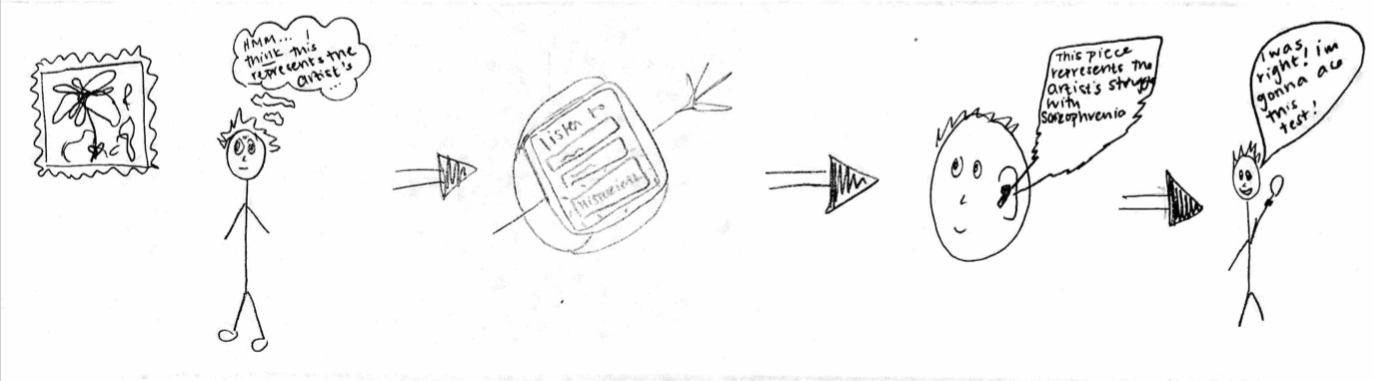
For students of art history (or, potentially, other fields as well) the smart watch can be used as a convenient way to review or learn history intentions and interpretations of art by selecting and listening to the “historical” option, as described in Task 2 for this implementation. The student could even quiz themselves by submitting interpretations that they think are in line with the expert opinion, and then comparing the two to check. The smartwatches could also be used for learning purposes in a less academically constrained way. If a teacher is trying to encourage her students to engage with art during a field trip to the museum, starting a friendly competition of who can accrue the most gold stars might be an effective way to encourage students to think about what they are seeing.
Mobile App
Task 1: Earn Rewards and Recieve Validation for Art Interpretations
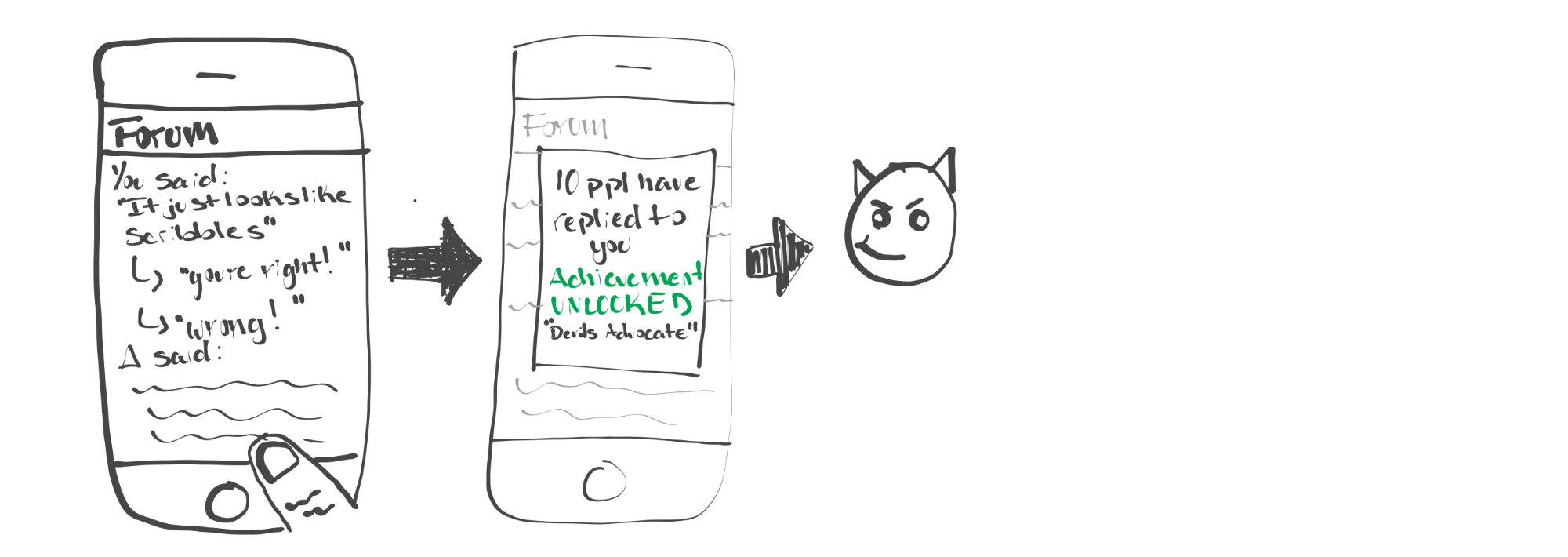
Museum visitors who download the phone app can post their opinions on the different art pieces into a public forum contained within the app. When certain posts become very popular, controversial, or verified, the user unlocks an achievement. There can also be other categories for miscellaneous posts such as art-specific humor or creativity. Rewards are based off of others opinions on your posts. A user would approach a painting, write down their comments within the app and post their comment.
Task 2: Create a Record of a Visit to a Museum
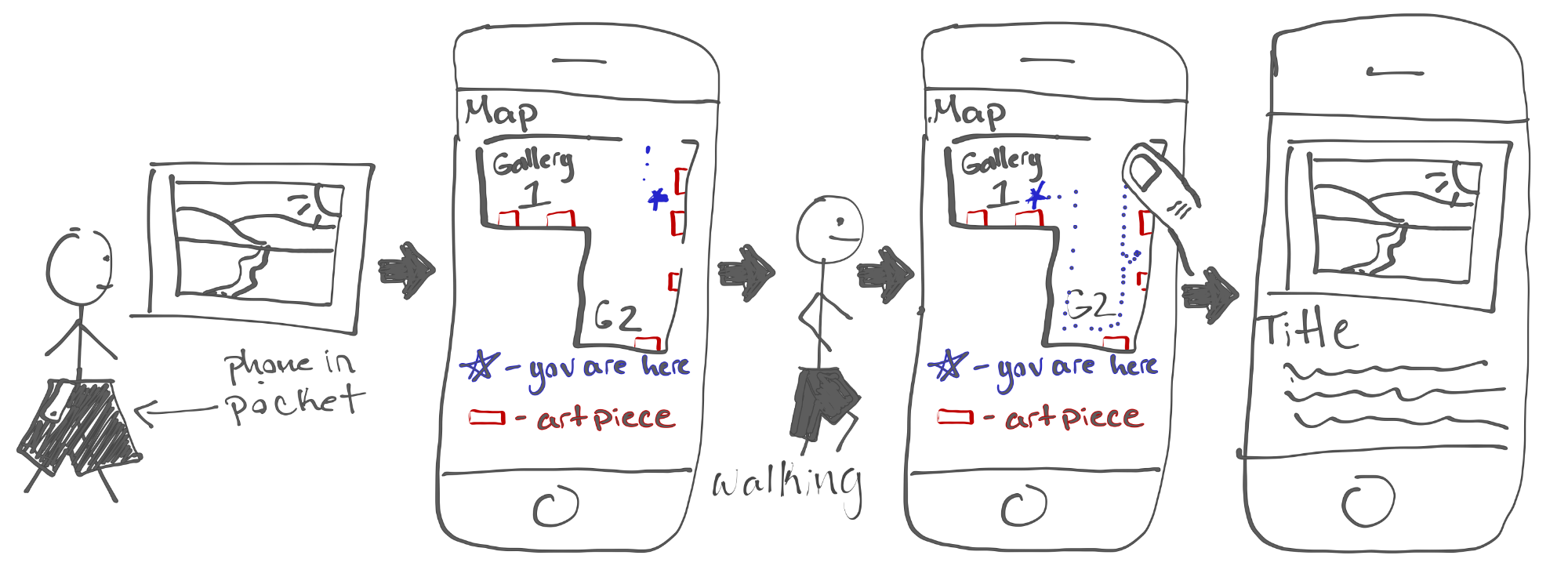
When a user wants to look back at their museum visit, they can opt to have their location tracked by the app so that their walking route is recorded. The map itself is interactive; the red squares indicate a piece of art and can be selected for further information. This feature would also be useful for general way-finding around a museum because the phone app could keep track of the users current location. Certain sections of the map can be labeled based on common themes. A user would open the app upon first arriving to the museum and simply walk around. They can later check their current location and their path when they open their phone.
Task 3: Use an Interactive and Educational Game to Teach/Learn
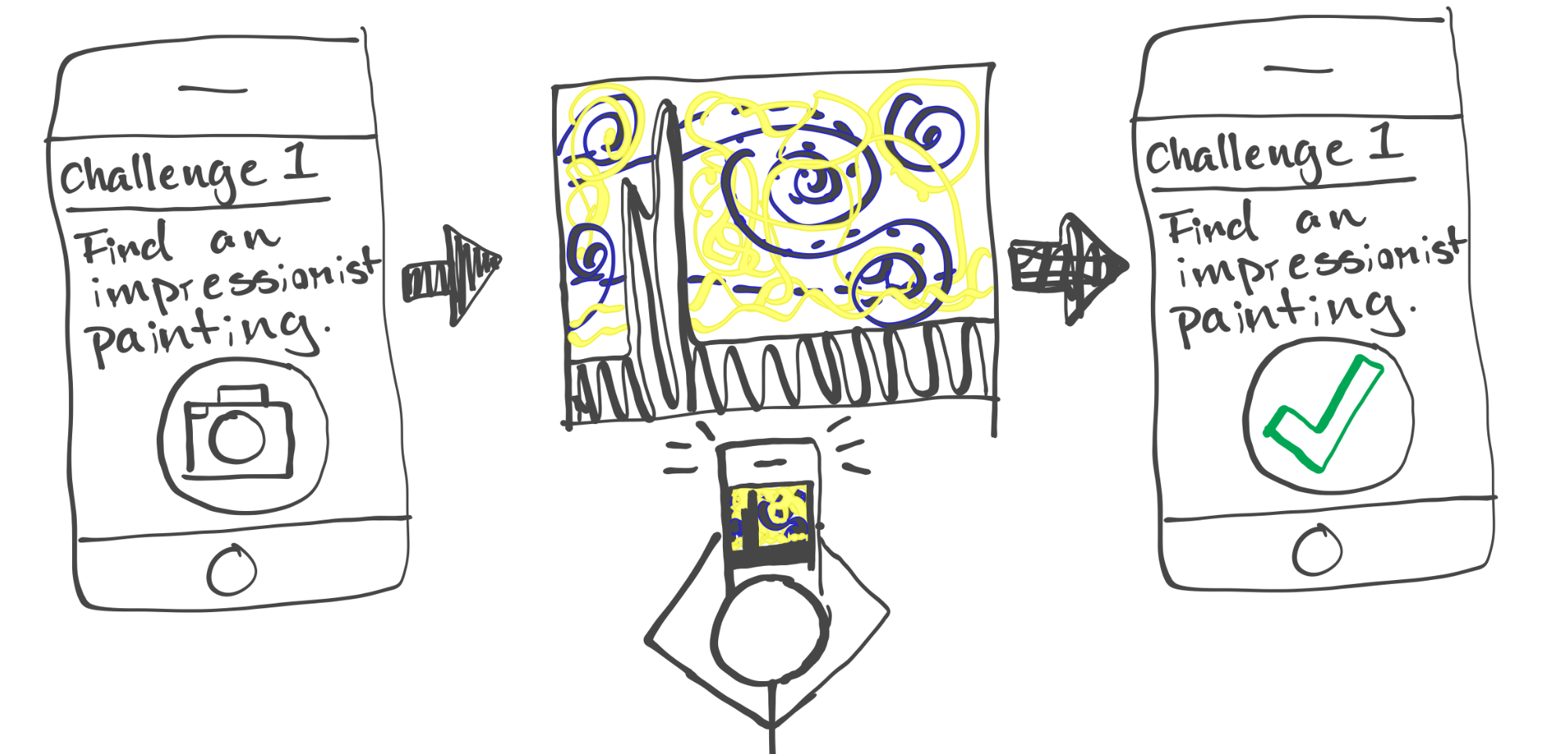
For those museum visitors that want a more interactive museum experience, they can open the app, avigate to the challenges/game section, and try to find the pieces described by the different prompts. These prompts could ask users to find art pieces based on a variety of different factors such as: artist, category, time period, geographical location, color scheme, symbols, etc. The app could also feature a create-your-own game section for both students and professors. Students could then look for their professor’s version of the app’s game and use it for studying or homework. A user would open the app upon first arriving to the museum, read the prompts and see if they encounter any paintings that satisfies a category. The app itself would use image recognition to verify when a user correctly chooses a piece.
Task 4: Facilitate Collaboration and Conversation About Art
When a museum visitor is pondering over a piece, they may not want to discuss the art outloud in order to not disturb the general atmosphere of the museum or they may not have anyone to discuss with at the moment. So the user opens the app and posts their opinions of the piece in the live forum. Any other visitors who happen to be nearby could see the recent comment on the piece and possibly strike up a conversation based on the comment. Within a group of friends, the forum could provide a place for all users to feel heard.